


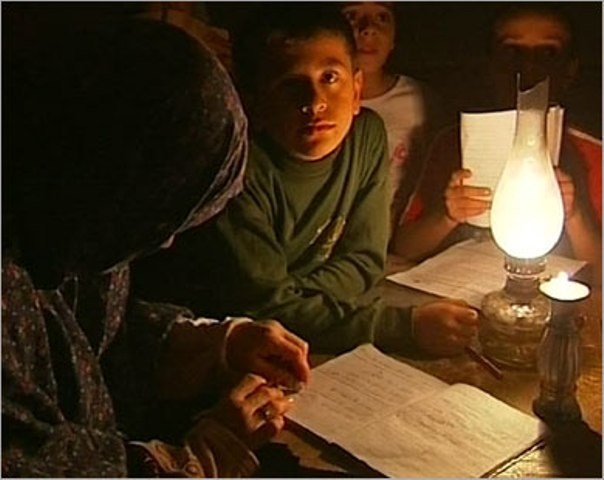
A number of students of general secondary in the Gaza Strip complained of frequent power cuts to their homes, and the continuation of this crisis without effective treatment until the moment, at the time they prepare to complete their review for final exams for this year.
They warned of the impact of the ongoing electricity crisis on their level of education, and getting high marks that qualifies them to go to the university, demanding at the same time to take into consideration the need to respect the students' interests, and solve the problem of electricity as soon as possible without any delay.
The student Ahmed Al-Sousi, 18, said that the crisis of frequent power failure has a significant impact upon him and all students, whereas, they couldn't study at night.
Al-Sousi showed that he heavily dependent on "Neon Charger," to illuminate his desk, to review the curriculum in the evenings, but he said that this is not a substitute for electricity.
Many Gazans depend on traditional alternatives to face the crisis of power outages from their homes.
Shadi Shbair, another student, expressed grumble for power cuts, and length of interruptions and beyond for the period per day for more than 8 hours, emphasizing that it has bad psychological impact on him.
He has shown signs of intense distress: "The problem is ongoing, and there is no solution, even though the exams started," expected to be another effect of the crisis on the possibility of obtaining high marks to qualify him for university study.
Accordingly, Shbair appealed the concerned authorities to reduce the electricity crisis and provide the appropriate atmosphere for them to study.
While the student Nermin Awad noted that the crisis of power outages affected negatively on all students, despite replacing it with some of the alternatives as candles, or use the neon charger.
Awad said: "It feels very tired from the study on lighting candles, while the alternative electrical generator, is turned off because of the inability of her father to buy it from the pump, since the crisis that has emerged clearly in the Gaza Strip a few months ago.
In turn, Director General of General Education at the Ministry of Education in Gaza, Mahmoud Mattar said that the frequency of power outages from the Gaza Strip from the homes of students significantly affects the overall educational process, particularly at the present time the high school students.
Therefore, Mattar called the international community and the United Nations and Red Cross and human rights organizations to hold their responsibilities and intervene to end this crisis and prevent interruption of electricity in the Gaza Strip.


