


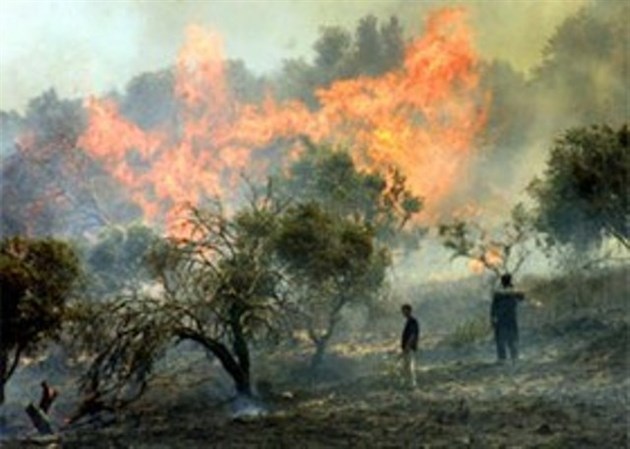
Flames started devouring tens of acres in Jenin area, when another fire was extinguished in Burin and Awarta, south of Nablus, such practices that reflect the occupation methodology in targeting land and man together .
The number of fires that targeted Palestinian lands and farms, has intensified in recent days, and increased noticeably during the current harvest season, raising fears of Palestinian farmers, and institutions that are concerned with development activity in general.
Attacks continue
Jewish offenders attacked Palestinian farms, and set fire in around 30 acres, cultivated with olive trees, near eastern gate of Yab’ad ,and a military checkpoint for the occupation forces.
Local villagers said that civil defense corps rushed to the scene and managed to extinguish the fire, which destroyed about 90 olive trees, and they prevented it from spreading to neighboring fields.
Other Jewish offenders from “Itamar settlement” built on Nablus territories, set blaze in a farmland of Madama village, south of Nablus, and one worker of civil defense corps was detained by the occupation forces, while heading to help in extinguishing the fire.
Abu Muhammad Awad, a farmer from Awarta village, said that the settlers torched different areas, in a way that contributed in hindering attempts to extinguish them, as fire brigades could not reach most of the fires points, especially at night.
Abu Ali, from the village of Azzun Atma in Qalquilia governorate , said that they spotted occupation forces while setting fire in farmlands of a village near barriers of barbed wire.
He added that an Israeli military vehicle set fire in a farmland near “Ornite” settlement, adjacent to the so-called green line, near the village of Kufr Kassim, which resulted in burning more than 40 acres cultivated with olive trees and cereals.
A Palestinian farmer from Radwan family said that dozens of attempts to burn lands were aborted during the last weeks, due to the vigilance of their owners who kept close to their lands.
Legalizing torching of Palestinian land
Arson acts against Palestinian lands have recently intensified, especially after an edict issued by a Jewish rabbi permitting Israelis to burn Palestinian crops and to poison their water wells.
The most dangerous of these arson acts, was probably the one that occurred in Hezma village neighboring Jerusalem , when Jewish settlers burnt more than 300 perennial olive trees (older than 400 years), in coincidence with occupation decisions to build new settlement units in the vicinity of the Holy City of Jerusalem.
According to official statistics, the area of agricultural land in the West Bank, including Jerusalem and Gaza, is estimated at 1488 sq.km which is equal to 25.2% of the total area of the West Bank and Gaza Strip. Meanwhile, the land’s area that rely on irrigated agriculture is 158.2 sq.km , which is equal to 10.6% of the total agricultural land , distributed as follows: 5.7% in the West Bank and 72.6% in the Gaza Strip that suffer from a shortage of rains.
On the other hand, the area of cultivated and irrigated lands in the Zionist settlements built on Palestinian territories is 70%, despite the fact that Zionist agriculture contributes only 2% of the gross domestic product, while the Palestinian agriculture contributes about 12.4% of the gross domestic product, according to statistics of 2004, noting that the contribution of the agricultural sector on the eve of the Zionist occupation in 1967 was around three times this figure.


